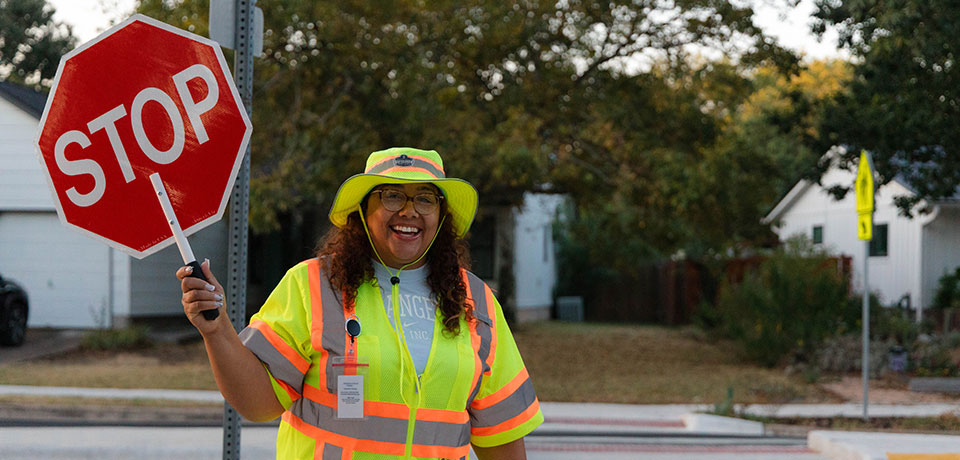
Crossing guard in Austin, TX. Source: City of Austin.
Thank you for crossing here: Strategies for crossing guard recognition
Introduction
Students arrive at school in a variety of ways – walking, biking, riding a school bus or public transit, driving with family members or in a carpool, or via some other mode. For many communities, crossing guards are valued parts of their school transportation safety systems. Whether in a city with crossings that have hundreds of student pedestrians or small communities with much fewer student pedestrians, crossing guards play key safety roles. They find gaps in traffic, raise their STOP paddles high in the crosswalk, and keep watch while students and families cross streets. Families and school staff rely on crossing guards for this important function and the sense of safety it brings.
When no crossing guard is available or staffing is unreliable, it can cause disruption and safety concerns. Therefore, communities want solutions for improving crossing guard recruitment and retention. In some places, the answers will be grassroots and low-cost recognition. In places with more robust programs, there may be more funding and options available. Understanding both the challenges of the position and why people are committed to the role are critical to planning and implementing strategies to keep crossing guards on the job.
This guide is meant for school community members, crossing guard managers, and others who know the value of crossing guards and want to see guards be recognized for their work and crossing guard locations reliably staffed.
Sources for this guide
Special thank you to representatives of crossing guard programs in Denver, Colorado; Austin, Texas; Chicago, Illinois; and Florida for sharing their experience. These representatives provided key lessons and challenges that helped inform this guide. Additionally, in some places readers will see quotes from those interviewed who provided a deeper understanding of the valued role of guards and the range of methods used to retain them.
The challenges of hiring and retaining guards
Across the country communities share a concern for finding and keeping great crossing guards.1, 2 Safety and physical health, atypical shift hours, and low pay are among the several factors impacting this widespread problem.
Safety and physical health
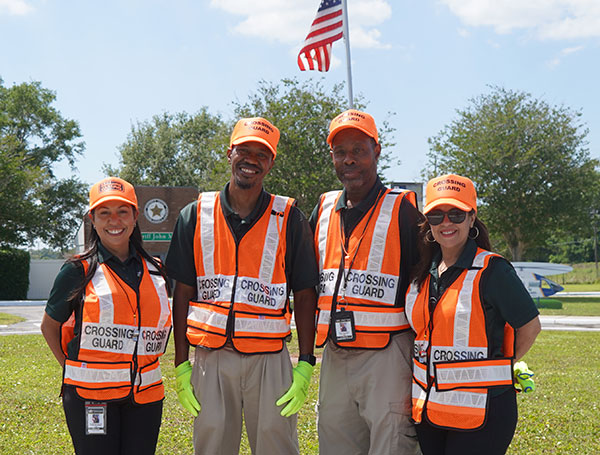
Orlando, Florida school crossing guards. Source: Florida Department of Transportation.
The work of the crossing guard is hard – it requires physical stamina to manage standing for extended periods in weather and temperature extremes and the mental fortitude to tolerate hostile drivers. As Amy Kenreich, a Denver parent and volunteer crossing guard notes, “I think sometimes the prevailing feeling is that crossing guards are beloved and appreciated, but that is not always the case. Not every driver is happy with the guard. Lots of drivers don’t seem to understand what their state statute says the guard is allowed to do.”
There’s also the risk of stepping into a crosswalk multiple times every day. In a study conducted by the New Jersey Safe Routes to School program, crossing guards reported encountering distracted drivers as a significant daily challenge. Using mobile phones, speeding, and ignoring crossing guard instructions are among the examples of careless driving cited in the study.3 An Associated Press article notes, “Over the past 10 years, hundreds of school crossing guards — many of them of retirement age or older – have suffered injuries on the job after being hit by a vehicle, and dozens of them have died.”4
In addition, weather conditions pose a risk for all crossing guards. Whether it be withstanding the hot Texas sun in Austin, or the frigid wind chills in Chicago, guards need to take extra precautions including sun protection and additional garments as part of their commitment to keeping students and themselves safe.
Aging workforce
For some communities, older adults are the primary demographic group serving as crossing guards. As guards age, they or their families may decide the work is too physically demanding or risky. “We’ll probably have a few resign over Christmas because like they go home or their family comes and like, hey, mom and dad, you shouldn’t be working anymore,” says Amir Emamian, City of Austin, Texas Safe Routes to School Program Manager.
Part-time schedule
Part of what makes hiring crossing guards a challenge is the split morning and afternoon work hours to coincide with when the school day begins and ends. For many potential workers, these hours may be inconvenient as they leave an awkward break in the middle of the day. To address this, some agencies assign a guard to all mornings and another guard to all afternoons. Agencies have begun to allow these split shifts in the hopes of making the position more convenient to attract new hires. Dana Crosby, Program Administrator of Florida’s Crossing Guard Training Program, said that in her 13 years on the job she had not seen acceptance of alternating shifts, but recently, “Some agencies are allowing it saying we’ll take what we can get and this way it doesn’t split up their day.”
Seasonal work
Crossing guard positions are seasonal, aligning with school calendars. This leads to increased turnover, as some crossing guards do not return after school breaks, often because they need to find a steadier source of income.2
Low pay or volunteer work
Depending on the community and its funding source, crossing guard programs may not offer competitive salaries, or in some cases, the role is volunteer only. Volunteer-based programs may offer cost savings, but guards may be less reliable. When families and school officials do not know whether a guard will be present, it causes safety concerns, and parents who can do so may choose to drive their child instead of allowing them to walk.
What do guards care about?
For paid guards, getting a paycheck can be an important reason to do the work. However, pay is likely not the sole reason crossing guards rise early in the morning. Each guard has their own combination of personal reasons for serving in the role. But based on what interviewed communities described, the categories of reasons below capture some of the most common ones. Considering these reasons can inform a recognition plan that speaks to what guards care about most.
Being a part of the local and school community
Guards do not only contribute to youth and pedestrian safety; often, they become fixtures of the communities they serve. When considering the many highs and lows of the job, guards put being a public servant as a top contributor to overall job satisfaction. A 2022 study by Allies for Children stated, “When asked what their favorite part about being a crossing guard is, 77.8% of the guards said working with children and families.”5
In Denver, Kenreich notes “when they start walking by themselves and then the parents eventually tell me, ‘my kid feels so proud that they can walk to school by themselves and it’s only because you’re at this intersection,’ that makes me feel super appreciated. And it goes a long way.”
Camaraderie with other guards
Outside of being active members of their communities, guards also greatly value having their own communities. Because crossing guards are typically working alone, they appreciate opportunities to connect with their colleagues. Whether it be during mandatory training sessions, celebratory end-of-year celebrations, or mid-year holiday parties, these events often serve as opportunities for guards to share stories and relax.
Andrea Garcia, Denver Public Schools School Crossing Guard Coordinator, believes in the power of creating time for guards to be together and plans opportunities for informal gatherings. Shared moments like these can strengthen morale, helping guards feel valued and supported by their team in meaningful ways. As additional support, Andrea also provides care packages to her team at the beginning of the year.
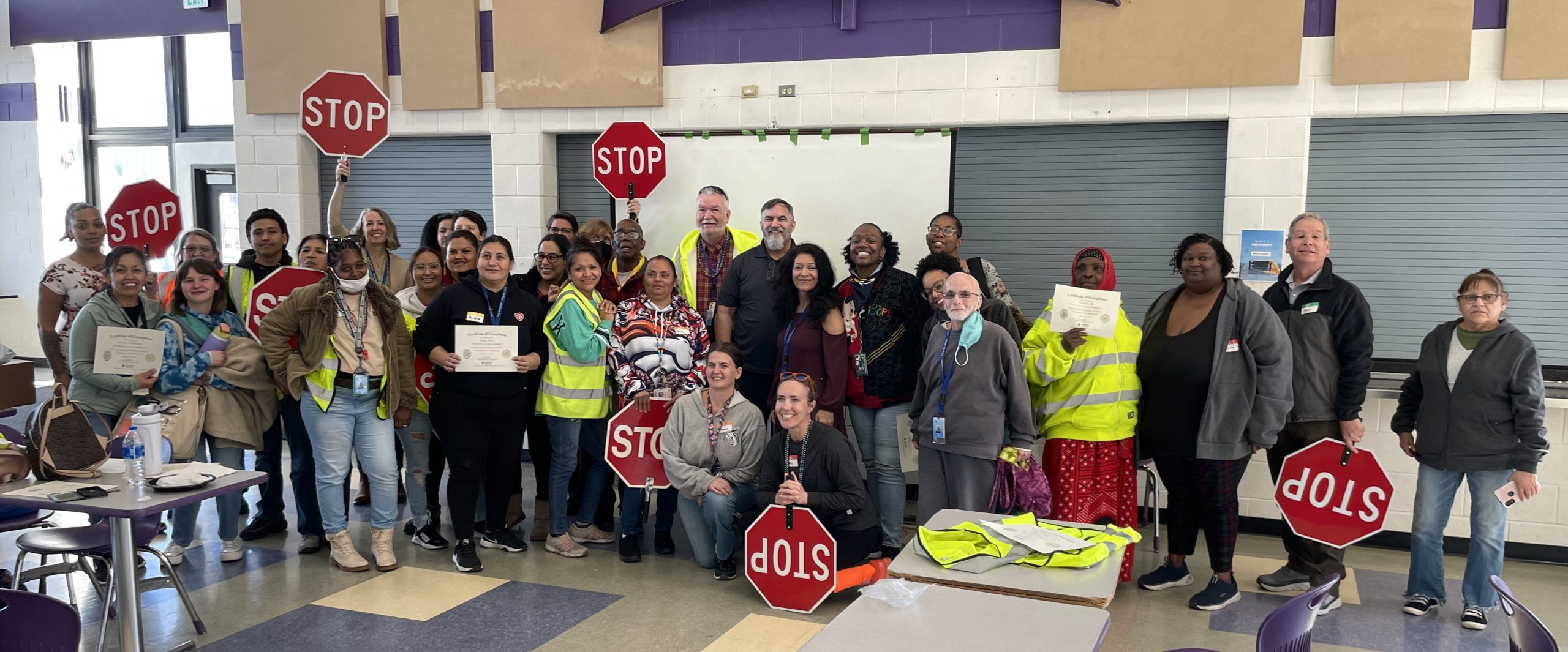
Crossing guards gather together in Denver, Colorado. Source: Andrea Garcia
Pay and benefits
Being a crossing guard is challenging, both physically and mentally. It’s important that guards are paid and incentivized adequately to reflect their hard work. Improving pay and benefits also helps mitigate hiring challenges. Places like Florida and Austin, Texas, have worked hard to increase wages. Cities are also offering competitive benefits in the forms of paid sick leave, vacation, and medical insurance. For example, Chicago offers those benefits as well as vision, dental, school break pay, and bereavement leave, making the crossing guard role a desirable one. In Austin, guards recognized as “Crossing Guard of the Year” receive an additional four hours of pay as a reward.
Opportunity for other jobs
While many guards are retirees, younger people are often drawn to the role not only for its contribution to school and community safety, but also because it can serve as a transitional position between other jobs or a pathway to future opportunities. For example, some Chicago crossing guards use this position as a stepping stone to other positions. The guards already know the students and are part of the community, making them ideal candidates for other roles within the school or district. The feeling is “you already know our students, we trust you, you’re part of our community,” says Crystal Carrington, Crossing Guard Manager of Chicago Public Schools.
Strategies that say thank you
Guard recognition can play a significant role in retaining staff. Whether it’s to applaud their caring attitude, years of service, staying calm when traffic is busy, or something else, showing that people care and notice the hard work can go a long way towards job satisfaction.
The budget and scale of the recognition can vary. For example, appreciation efforts at a single school with little or no budget will be different than what a citywide, or even statewide, crossing guard program can do. The organization leading the effort may also influence which appreciation strategies are most appropriate. Regardless of magnitude, there is value in celebrating a guard’s role and efforts.
When planning appreciation efforts, communities may want to consider the following:
- Is this a one-school or multi-school effort?
- What funding is available?
- What community-based organizations can help? (e.g., PTAs, local businesses)
- What is the best time and setting to recognize guards?
- How much time is available to plan?
The following four sections rang from relatively quick-to-implement strategies to thsoes that require more time and planning.
Quick, meaningful gestures
While the feelings of appreciation may be big, sometimes the budget and timeline don’t match. These strategies focus on high visibility and taking advantage of existing opportunities to recognize guards at their locations.
- Make a banner and hang it near the guard’s corner. If there’s nowhere to hang it, consider sidewalk chalk instead.
- Provide cards to families and ask them to retunr the written appreciation to the guard (or one person can collect and present them).
- Use National Walk & Roll to School Day or National Bike & Roll to School Day to integrate thank yous to the school crossing guards during event activities and communications.
- Post a thank you on social media with a photo and short appreciation message.
- Promote a “Dress Like a Crossing Guard Day” where students wear the classic yellow or other safety colors to show support.
Gifts that last the whole year
Provide guards with tangible gifts that serve a purpose during every shift while honoring their commitment to being part of the crossing guard team.
- Create a custom calendar that shows school holidays, early release days, and other key events for crossing guards.
- Gift a gift bag that includes equipment guards need for both their safety and that of pedestrians while on duty. By keeping all their essentials in one place, guards are less likely to forget important items.
- Give guards service pins as visible representations of their experience and dedication. Many guards have been on the job for years, some even decades, making these pins a meaningful way to celebrate their commitment
Special events
Hold a special event to publicly honor crossing guards and thank them for their commitment. Appreciation breakfasts, recognition ceremonies, or school assemblies increase the visibility of crossing guards’ work, strengthening community appreciation.
Chicago Public Schools (CPS) proudly celebrates the dedication and commitment of its crossing guards at an annual ceremony. Held during lunchtime in between shifts, the ceremony provides guards an opportunity to build community with one another and enjoy a buffet-style meal. During the event, the four recipients of Crossing Guard of the Year awards are recognized for going above and beyond. Those who have reached 45 years of service are specially honored, and that spirit of recognition shines through every level of service.
In Florida, crossing guards across the state are recognized annually on the first Friday of February. At Seminole County Sheriff’s Office, the management team serves guards breakfast. Guards are given a gift, recognized for perfect attendance, and thanked for their service. In addition, the governor typically signs a proclamation on the day, honoring the guards and their dedication to promoting pedestrian safety.
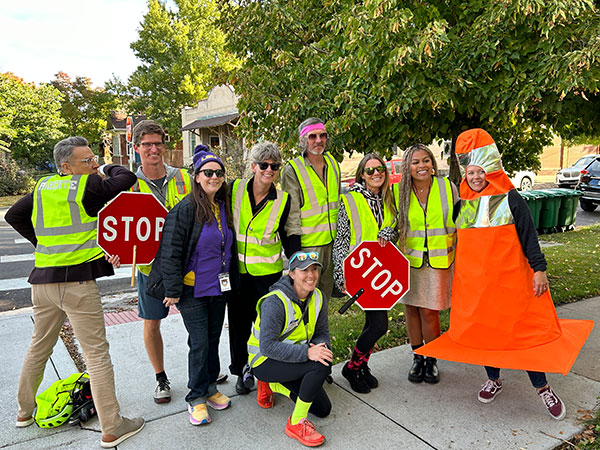
Amy Keinreich, with local celebrities including a local reporter, musicians, and school officials in Denver, Colorado. Source: Amy Kenreich
In Denver, Colorado, Kenreich made it her mission to address the shortage of crossing guards in Denver Public Schools. Instead of relying on traditional advertising, she took a more creative approach. She launched a “Celebrity Crossing Guard” event that paired local community figures with crossing guards for a shift, giving them firsthand experience in the role. The timing aligned with the community’s Walk and Bike to School Day, one of the busiest days of work for crossing guards in the district. Not only did the event successfully raise awareness and attract new guards, but it also gave community leaders a deeper understanding of the challenges and importance of the job.
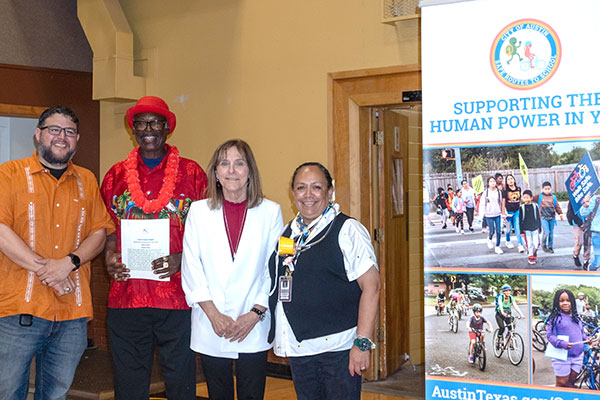
Crossing Guard recognition luncheon in Austin, Texas. Source: Amir Emamian
Austin’s formal appreciation event takes place at the end of every school year. Crossing guards are treated to a luncheon to accommodate morning and afternoon shifts. The luncheon gives guards the chance to enjoy a meal and connect with one another, all while receiving two additional hours of pay. Those who win Guard of the Year or Guard of the Area receive four additional hours of pay. Luncheons are themed, changing from year to year; past themes included carnival, rock’n’roll, movies, and a talent show. Gifts are also given to crossing guards. The gifts are typically practical items that relate to work, such as insulated lunch bags and reusable water bottles.
Award Programs
Award programs are meaningful ways to recognize crossing guard dedication and show genuine appreciation for their daily impacts. This recognition not only honors crossing guards’ service, but also invites students, parents, and community members to participate in appreciation efforts.
In Austin, guards are often going above and beyond their job responsibilities in the name of keeping their community safe. With Austin’s “Caught You Caring” program, guards can receive shout-outs for displaying exemplary behavior and be recognized for it. “Caught You Caring” provides a built-in system for community members who notice guards’ hard work and want to be able to thank them any day of the year. A “Caught You Caring” nominee receives two additional hours of pay. In addition, Austin crossing guards are awarded pins for every five-year increment of service as a token of their dedication.
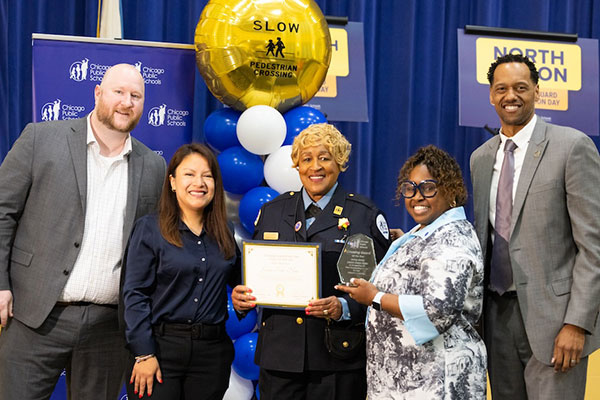
Crossing guard appreciation includes school and elected officials in Chicago, IL Source: Chicago Public Schools
In Chicago, four guards will receive Crossing Guard of the Year, one for each of the four city regions. During Crossing Guard Appreciation Month, CPS’s crossing guard program sends out a memo to schools, including a form for people to nominate and vote for their favorite crossing guard. This system allows guards to be recognized for their hard work and be celebrated for exceeding expectations. The form is also sent to guards, and they are encouraged to vote for their colleagues and share with family. This form is not just a mechanism for Guard of the Year, it also allows the community to share input that provides managers with insight into what’s working and what’s not.
Florida’s Crossing Guard of the Year is chosen through a nomination process open to the public. There’s a public landing site that can be accessed by students, families, community members, and crossing guards. No matter the number of nominations received, all nominees receive a personal letter and pin as recognition for their exceptional service. All nominations are reviewed by a committee and objectively scored based on a set of criteria. Sometimes there are so many deserving nominations that the committee decides to also give an “Extra Mile” award to one or two more guards. Together, these efforts aim for nominated guards to feel valued and acknowledged for their service.
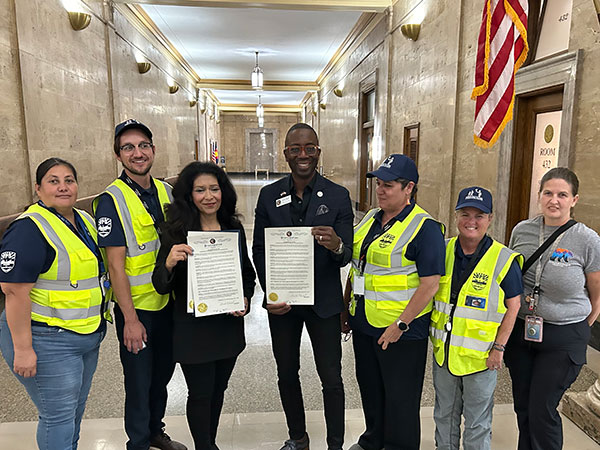
Crossing guard recognition in Denver, Colorado. Source: Andrea Garcia
Crossing guards in Denver are honored each year for their service during a team meeting. These meetings serve more as a celebration, as the gatherings are filled with applause, gratitude, and a shared sense of pride in the work guards do. Each year, one or more guards are recognized for going above and beyond. These individuals who’ve demonstrated exceptional dedication or persevered through particularly tough challenges receive an engraved plaque. To ensure every guard feels appreciated, all guards are also given a certificate recognizing their ongoing commitment to student safety and the vital role they play in their community.
Conclusion
Whether planning a few small activities or a grand event, showing crossing guards that they are noticed and valued can make a difference in retention. As Crosby notes, the state’s expansive appreciation program “not only makes people realize the value of guards and the appreciation, but it increases safety.” For any school or community, it’s valuable to use appreciation strategies to strengthen relationships, reinforce safety, and express gratitude for the individuals who help protect our students every day.
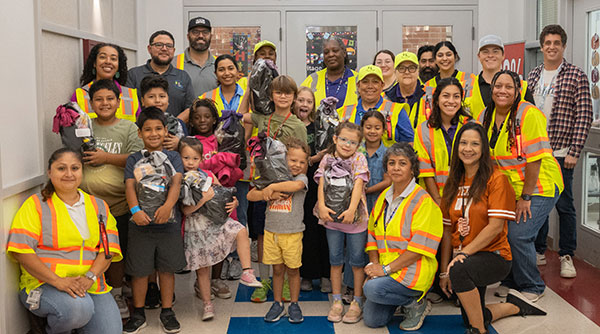
Crossing guards and families on Walk & Roll to School Day in Austin, TX.
Source: City of Austin
Resources
Acknowledgments
The authors wish to thank Crystal Carrington, Chicago Public Schools; Dana Crosby, Florida Department of Transportation; Andrea Garcia, Denver Public Schools; Amy Kenreich, Denver volunteer; and Amir Emamian and Leticia Richardson, City of Austin. Each of these experts took time to explain their crossing guard programs, the importance of recognition and recognition strategies. This guide was made possible with support from GM.

Suggested Citation
Bavon, B., & Pullen-Seufert, N. (2026). Thank you for crossing here: Strategies for crossing guard recognition. National Center for Safe Routes to School.https://www.saferoutesinfo.org/toolbox/crossing-guard-appreciation-guide/
References
1 Radebaugh, S. (2025, August 18). Williamson County Sheriff’s Office fills crossing guard gaps amid shortage. WKRN News. https://www.wkrn.com/news/local-news/middle-tn-neighborhood-news/williamson-county-sheriffs-office-fills-crossing-guard-gaps-amid-shortage/
2 San Francisco Municipal Transportation Agency. (2025, August 25). Prioritizing safety at schools citywide: An update on our crossing guard program. https://www.sfmta.com/blog/prioritizing-safety-schools-citywide-update-our-crossing-guard-program
3 Bull, C., & Von Hagen, L. A. (2014). The role of crossing guards and child pedestrian safety in New Jersey. New Jersey Safe Routes to School. https://www.njcrossingguards.org/wp-content/uploads/2023/12/The-role-of-crossing-guard-and-child-pedestrian-safety-in-NJ.pdf?#page=9.39
4 Garner, D., Panjwani, H., Kessler, A., Butler, S., Terry, T., & Daniel, T. (2025, November 7). School crossing guards face danger, death on the job. Associated Press News. https://apnews.com/article/school-crossing-guard-fatal-traffic-accidents-725e0fdb61dd1246318028de92bc7add
5 Larson, T. K., Bagnato, S. J., Crothers, L., Brier, K., Kimmel, T., & Borden, K. (2015). The crossing guard study: An analysis of the positive roles for child safety and mentoring. https://alliesforchildren.org/wp-content/uploads/2022/09/CrossingGuardsStudy.pdf